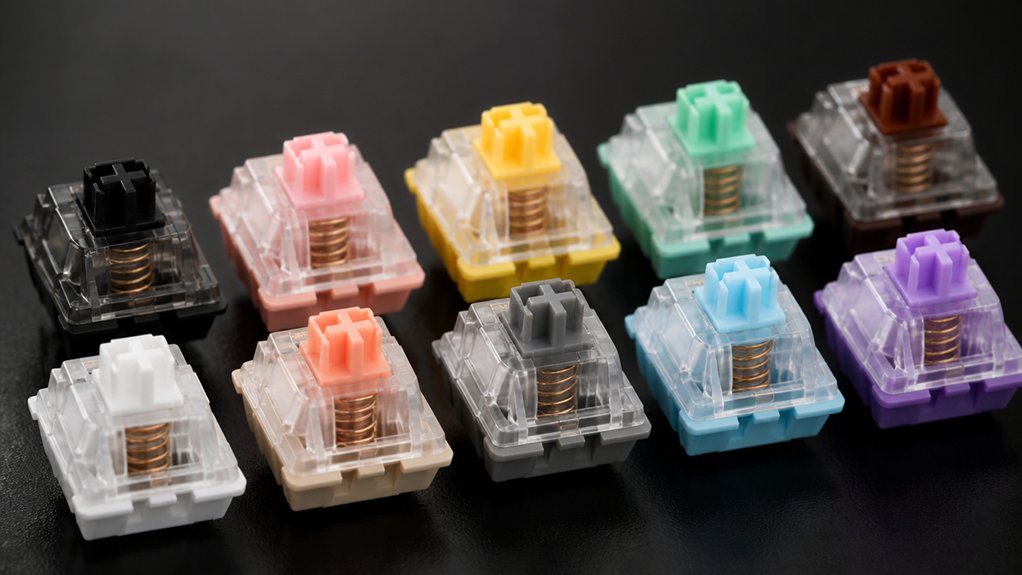
You’ll love the Cherry MX Silent Red for its classic 45 gf smooth feel and built‑in silicone pad that cuts noise by 2–3 dB. The Silent Alpaca Linear steps up with pre‑lubricated POM stems and a gasket‑mounted design for ultra‑quiet typing. Kailh Box Silent offers a sturdy housing with foam‑filled dampening and factory lubrication. Gazzew Boba U4T gives a tactile bump while staying low‑volume, and Orange Healio Low‑Volume Linear delivers buttery smoothness with an integrated LED slot. All are MX‑compatible, 5‑pin, and last for 50‑60 M keystrokes, so you can type confidently without disturbing anyone. Keep reading to discover how spring weights, DIY lubrication, and maintenance can fine‑tune your silence.
Why Quiet Mechanical Switches Matter for Silent Typing
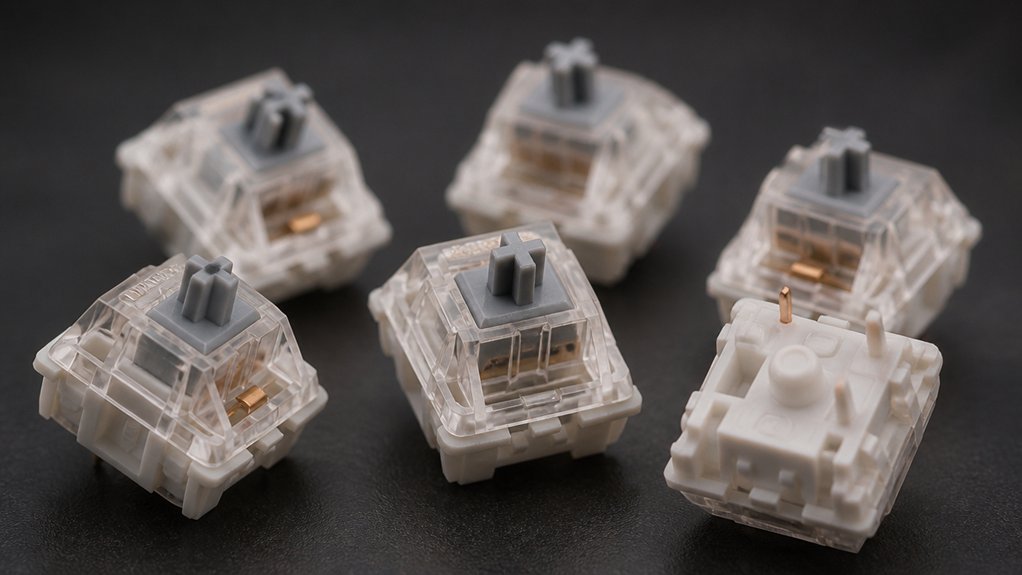
Because you often type in shared spaces or late‑night environments, the noise a keyboard makes can become a real distraction. Silent, quiet mechanical keyboard switches give you the tactile or linear feel you love while keeping the clack to a whisper.
They use internal dampeners, silicone rings, or factory‑applied lubrication that mutes each keystroke, so you can work in libraries, open‑plan offices, or late‑night rooms without annoying coworkers. The built‑in dampening also smooths bottom‑out and top‑out impacts, delivering quiet operation without extra mods.
With 5‑pin MX cross‑stem compatibility, you can drop them into most boards, and their 50‑60 million keystroke lifespan guarantees the silence lasts for years. This combination of comfort, durability, and low‑noise performance makes quiet switches essential for any silent‑typing setup.
How to Evaluate Switch Noise: Decibel Levels, Stem Design, and Dampening Features
You’ll start by measuring the switch’s decibel output with a calibrated sound meter under consistent typing conditions.
Then, examine the stem’s material and shape, because tighter tolerances and dust‑proof covers cut down wobble and rattling.
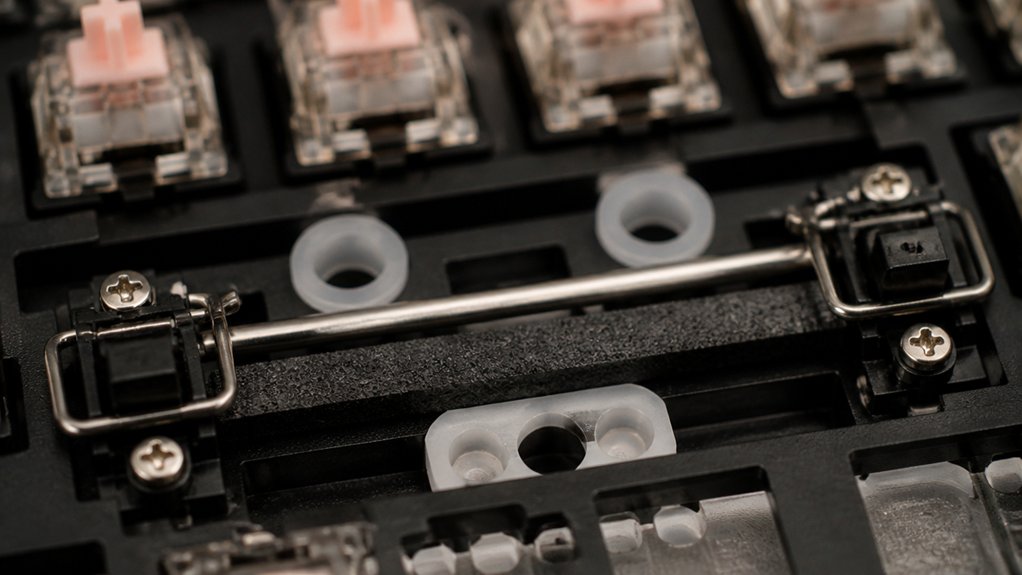
Finally, look for built‑in dampening—silicone rings, foam pads, or lubricated grooves—that absorb impact noise at both bottom‑out and top‑out.
Ibel Measurement Techniques
When you assess Ibel switch noise, start with a calibrated decibel measurement using a force tester coupled to a sound‑level meter or USB analyzer, ensuring repeatable data across keypresses. Record peak dB values for actuation and bottom‑out, then average multiple strokes to smooth out anomalies.
Next, examine the stem’s geometry: precision‑machined grooves and dust‑proof covers keep the stem stable, cutting rattling that would otherwise raise switch noise.
Test dampening components—silicone rail silencing, internal pads, and silicone rings—by swapping them in and out while monitoring dB changes; a drop of 2–3 dB signals effective vibration absorption.
Finally, verify that pre‑lubrication spreads evenly across the stem, reducing high‑frequency clicks and delivering a truly quiet switch experience for any mechanical switches you evaluate.
Stem Material Dampening Design
If you want a truly quiet keystroke, start by examining the stem’s material and geometry, since high‑grade POM reduces friction and eliminates high‑frequency rattles. In mechanical keyboards, a stem material engineered for low‑noise performance typically features tight tolerances and a smooth, polymer‑rich surface that resists wear.
Look for dampening design elements such as silicone pads, internal rings, or dust‑proof covers that absorb shock and curb wobble during bottom‑out and return strokes. Factory‑applied lubrication, routed through precision grooves, further smooths travel and lowers decibel peaks.
A stable 5‑pin construction adds rigidity, preventing rattle and ensuring a silent switch experience. By measuring decibel levels under standardized force curves, you can verify that these combined stem material and dampening strategies deliver the quietest typing environment.
Linear Quiet Switches: Cherry MX Silent Red – Classic Low‑Profile Performance
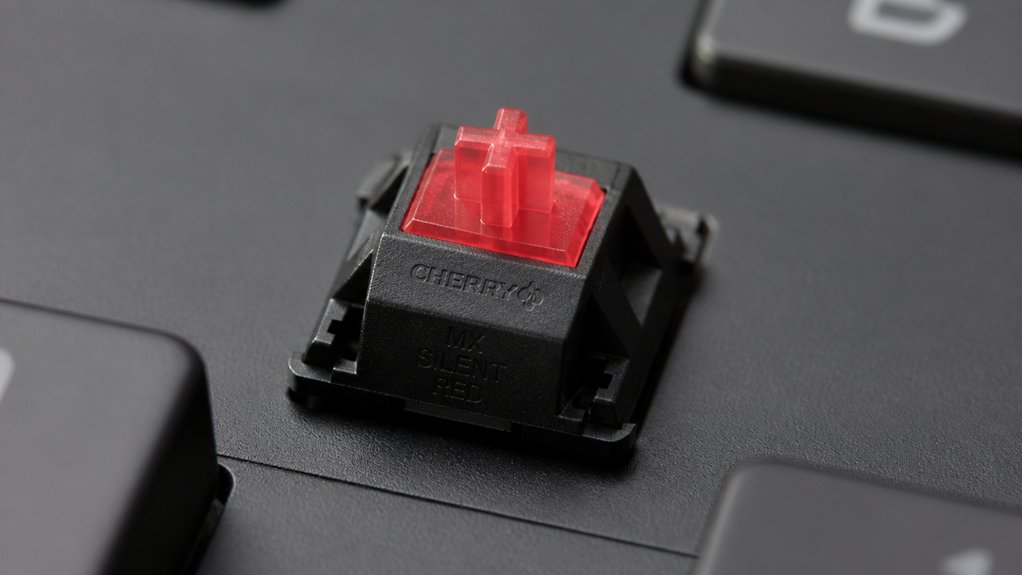
Although they look like any other MX switch, Cherry MX Silent Reds deliver a smooth, linear feel while muting the usual “clack” of key bottom‑out, thanks to an internal dampening pad.
Cherry MX Silent Reds provide smooth, linear typing while muting the typical bottom‑out clack.
You’ll notice the low actuation force—about 45 gf—makes typing and gaming feel effortless, and the cross‑stem design guarantees compatibility with most MX‑style caps and hot‑swap boards.
The built‑in sound‑dampening keeps each keystroke quiet, perfect for shared offices or late‑night sessions.
Durability isn’t an issue; you get roughly 50 million keystrokes before wear becomes noticeable.
When you press a Cherry MX Silent Red, the linear travel provides consistent resistance without tactile bumps, letting you focus on speed and accuracy while maintaining a serene workspace.
Linear Quiet Switches: Silent Alpaca Linear – Premium Pre‑Lubricated Ultra‑Quiet Build
Even though it’s ready out of the box, the Silent Alpaca Linear delivers ultra‑quiet performance thanks to its gasket‑mounted stem and built‑in silencing pads, so you won’t need any extra mods.
You’ll feel the smooth typing experience immediately because it arrives pre‑lubricated, eliminating scratchiness and ensuring consistent linear travel. The MX‑style cross stem and 5‑pin layout fit most hot‑swappable boards, except low‑profile, optical, or magnetic models.
Internal dampening material mutes both bottom‑out and top‑out impacts, making it a top contender for the quietest mechanical keyboard in shared offices or libraries. Its premium feel and durability give you a reliable Silent Mechanical solution that stays quiet day after day without additional tinkering.
Linear Quiet Switches: Kailh Box Silent – Sturdy Housing With Built‑In Sound‑Absorbing Design
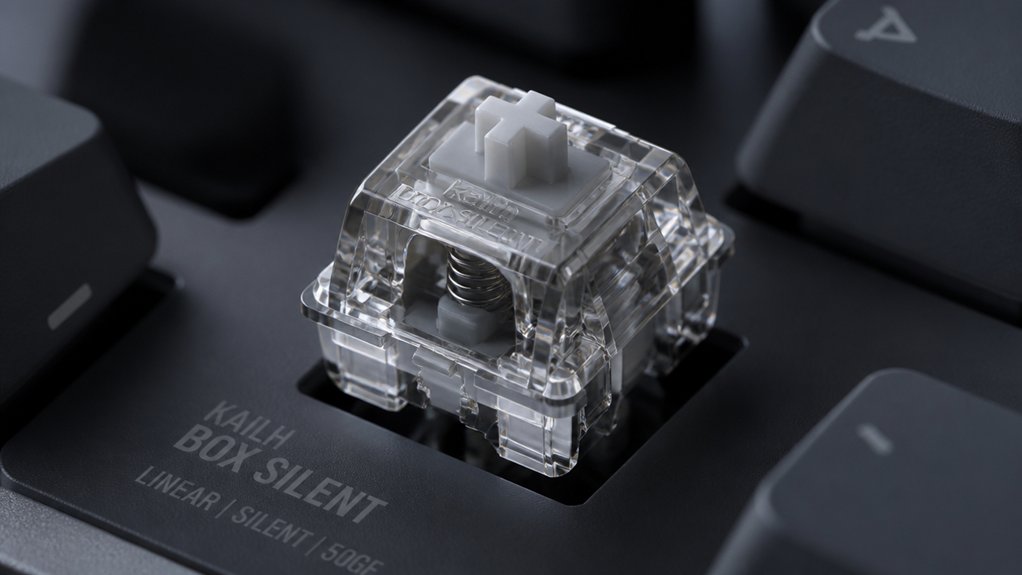
Because its housing is engineered with built‑in sound‑absorbing material, the Kailh Box Silent delivers a sturdy, whisper‑quiet typing experience.
You’ll notice the linear feel right away: no tactile bumps, no clicks, just smooth keystrokes that glide across the board. The robust housing keeps wobble to a minimum, while factory lubrication and the dampening chamber keep noise down even during rapid typing sessions.
Compatibility isn’t an issue—standard MX cross‑stem lets you swap keycaps on any Mechanical Keyboard without hassle.
- Durable, low‑wobble construction – reduces vibration and stabilizes each press.
- Integrated sound‑absorbing layer – mutes echo, perfect for shared spaces.
- Factory‑lubricated linear action – guarantees consistent, fast response without sacrificing quietness.
Tactile Quiet Switches: Gazzew Boba U4T – Strong “Thocky” Feel With Subtle Sound
If you want a tactile switch that still stays quiet, the Gazzew Boba U4T delivers a strong, rounded bump with a 59 gf peak and 42 gf actuation, giving you a satisfying “thock” without a loud click. Its 2.3 mm pre‑travel and 3.1 mm bottom‑out let keys register fast while the long stem throw preserves tactile feedback.
Factory‑applied light lubrication and tight tolerances keep keystrokes smooth, stable, and free of wobble right out of the box. The acoustic profile is deep yet subtle, making it perfect for shared or office spaces where you need quiet mechanical keyboard switches.
With a 60 million‑stroke lifespan and a standard 5‑pin MX footprint, the Gazzew Boba U4T blends durability, performance, and a refined “thocky” feel.
Tactile Quiet Switches: Akko V3 Cream Blue Pro – Budget‑Friendly, Pre‑Lubricated Tactile
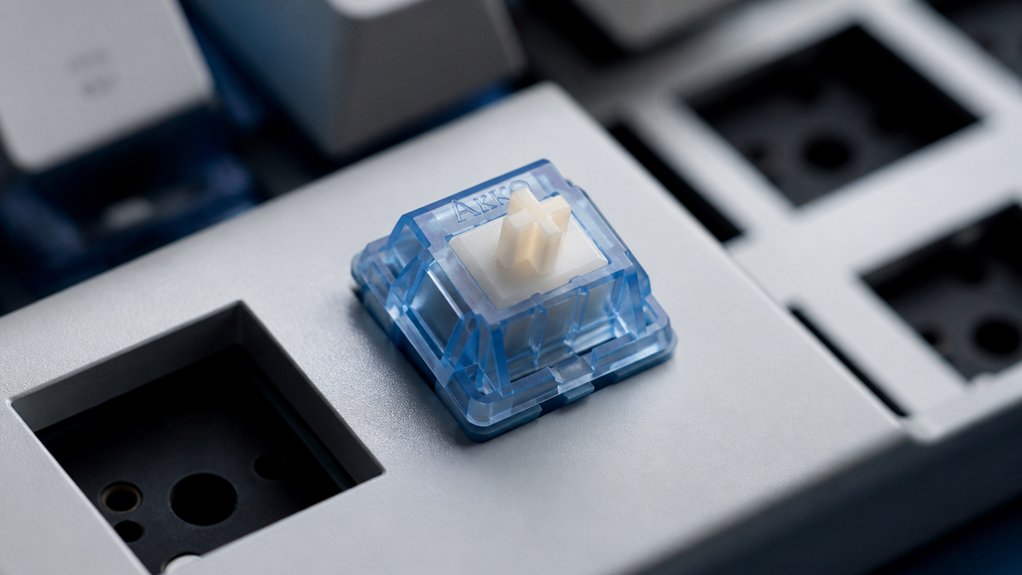
While keeping costs low, the Akko V3 Cream Blue Pro delivers a solid, medium‑weight tactile bump that feels smooth thanks to factory pre‑lubrication. You’ll notice a dustproof stem cover that steadies the switch, cutting wobble and boosting confidence during fast typing sessions.
The pre‑lubricated tactile feel means you can plug it in and start typing without any aftermarket mods, keeping the experience budget‑friendly and hassle‑free. Its sound profile is slightly louder and higher‑pitched than the original, but the overall noise remains low enough for shared spaces.
Plug‑in, type instantly with pre‑lubricated smooth tactile; louder yet still low‑noise for shared spaces.
- Dustproof stem cover for stability
- Factory pre‑lubrication guarantees smooth tactile response
- Budget‑friendly price without sacrificing build quality
Capacitive Quiet Switches: Topre Type‑S – Soft Click‑Free Experience for Office Use
Even in a bustling office, the Topre Type‑S lets you type with a soft, click‑free feel that stays whisper‑quiet. Its electrostatic capacitive design pairs a conical spring with a rubber dome, giving you a smooth tactile “thock” without the clatter of traditional switches. The silencing technology dampens bottom‑out and top‑out sounds, delivering silent operation that fits quiet office environments. Durable construction means the feel stays consistent for years, and the switch’s low actuation force reduces finger fatigue during long sessions. You’ll notice the subtle depth of each keystroke, yet coworkers won’t hear a thing—perfect for shared workspaces.
| Feature | Benefit |
|---|---|
| Capacitive design | Soft, click‑free feel |
| Rubber dome | Dampened bottom‑out noise |
| Silencing tech | Silent operation |
| Durable build | Long‑term quiet productivity |
Low‑Volume Linear Switches With Integrated LED Slots: Orange Healio
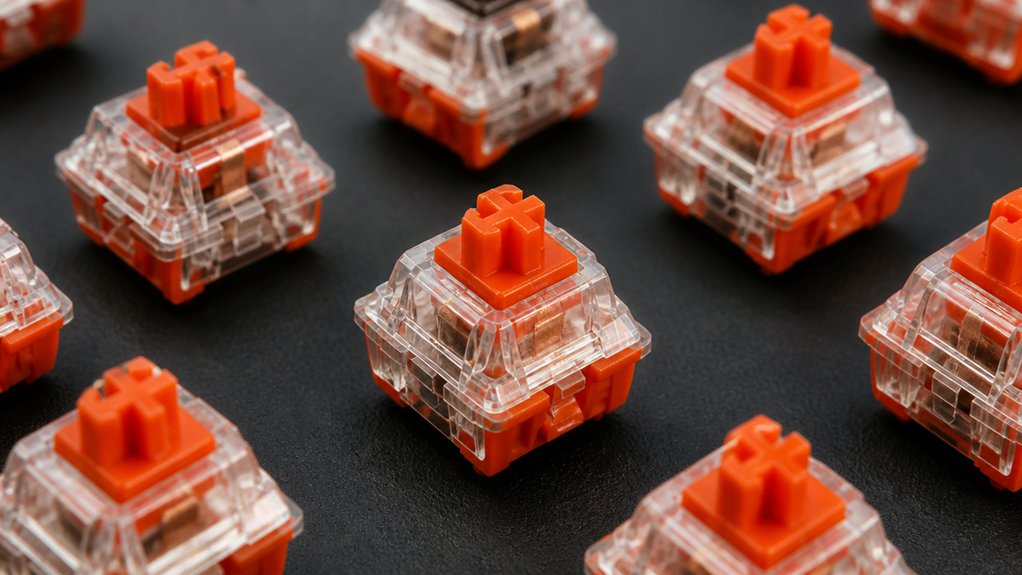
Orange Healio switches deliver ultra‑quiet linear performance while showcasing vivid RGB lighting through their transparent housing and built‑in LED slots. You’ll notice the low‑volume linear design eliminates any tactile bump, letting each keystroke glide silently—perfect for shared offices or late‑night gaming.
The pre‑lubricated internals keep the actuation buttery smooth straight out of the box, and the clear case lets your custom lighting shine without sacrificing durability. When you pair them with MX cross‑stem keycaps, the result feels like the best linear switches you can find for a quiet desk.
- Transparent housing with integrated LED slots for vivid RGB effects
- Factory pre‑lubricated internals guarantee consistent low‑noise operation
- Compatibility with most MX cross‑stem keycaps and hot‑swappable boards
Pre‑Lubricated vs. DIY Lubricated Quiet Switches – Which Gives the Best Silence?
You’ll notice that pre‑lubricated switches give you consistent, factory‑set smoothness right out of the box, while DIY lubrication lets you fine‑tune the type and amount of lube for a truly personalized sound profile.
The noise‑reduction impact can differ noticeably, especially on budget tactile switches where factory lubrication is often lacking. Deciding which route delivers the quietest keystroke depends on whether you value instant, reliable silence or the potential for even lower noise through custom tweaking.
Lubricated Consistency Guarantees
Because factory‑pre‑lubricated switches like the Gazzew Boba U4T and Akko V3 Cream Blue Pro already come with evenly applied grease and engineered lubrication, you get a reliably smooth, quiet feel straight out of the box. Their design guarantees consistent smoothness and reduced noise for tens of millions of keystrokes, so you don’t need to worry about uneven wear or unexpected squeaks.
When you compare that to DIY attempts, the factory route eliminates guesswork and the time‑consuming trial‑and‑error that can introduce variability.
- Precise application methods create uniform lubricant layers.
- Specialized grooves keep grease in place, preserving long‑term performance.
- Standardized damping guarantees the same quiet profile across every unit.
You’ll appreciate the peace of mind that comes from knowing each switch behaves predictably, delivering the silence you expect without extra effort.
DIY Lubrication Customization Options
If you’re weighing pre‑lubricated switches against a DIY approach, the key question is whether the factory‑set quietness or the tailored silence you can achieve yourself matters more for your typing experience.
Pre‑lubricated switches arrive with precision‑machined grooves that deliver instant smoothness and a consistent low‑noise baseline, so you can plug in a board and start typing without extra work.
DIY lubrication, on the other hand, lets you pick the exact grease or oil, control the amount, and target high‑pitched tappy frequencies that stock lubrication may miss. This customization can push quietness beyond what factory‑set options provide, but it requires disassembly, careful application, and carries a risk of uneven coating or damage.
Weigh the convenience and uniformity of pre‑lubricated switches against the potential for finer sound suppression and personalized smoothness that DIY lubrication offers.
Noise Reduction Impact Comparison
When you compare pre‑lubricated quiet switches to DIY‑lubricated ones, the difference in noise reduction boils down to consistency versus ultimate silence.
Pre‑lubricated quiet switches give you a smooth, low‑profile sound straight out of the box, while DIY lubrication lets you fine‑tune each stem for maximal hush.
In a sound test, the factory‑lubed models stay steady across millions of keystrokes, whereas a well‑lubed DIY set can shave off the last high‑pitched tappy edge.
- Factory pre‑lubricated switches provide uniform lubrication and reliable quietness.
- DIY lubrication offers deeper, customized silence when applied skillfully.
- Both methods pass a sound test, but DIY can edge out pre‑lubricated for absolute quiet.
Selecting Spring Weight for Quietness and Tactile Feedback
Choosing the right spring weight lets you balance quietness with tactile sharpness: lighter springs (about 42 – 44 g) in switches such as the Gazzew Boba U4T keep the tactile bump crisp while reducing bottom‑out noise, whereas heavier springs (65 – 69 g) cushion the impact further, muting sound at the cost of a softer bump and more finger fatigue.
You’ll notice that lighter springs shorten the travel distance before the actuation point, letting Typing feel snappier without a loud thud. Heavier springs extend the travel, softening the bump and absorbing impact, which dials down volume but can make long sessions feel tiring.
Pre‑lubed switches with the right spring weight keep the glide smooth, preserving consistent feedback while staying quiet. Balance personal preference for crispness versus cushioned silence to pick the ideal spring.
Compatibility Checklist: 5‑Pin vs. 3‑Pin, PCB Mounts, and Hot‑Swap Boards
Because hot‑swap boards often accept both 3‑pin and 5‑pin MX‑style switches, you first need to check whether the PCB has the extra holes for the two stabilizing pins. If the board only has three holes, you’re limited to 3‑pin switches; if it includes the extra slots, you can use the more stable 5‑pin variants.
Verify that the plate mounting matches the switch layout, because a plate‑only design may reject 5‑pin pins.
Finally, confirm the board’s hot‑swap sockets are rated for the switch you plan to install, guaranteeing reliable contact and quiet performance.
- Look for extra holes that accommodate the two stabilizing pins.
- Ensure the plate’s cutouts align with the switch’s stem and pins.
- Check that the hot‑swap sockets support the chosen switches available, whether 5‑pin or 3‑pin.
Installation & Maintenance Tips to Preserve Silence After 50 M Keystrokes
After confirming that your hot‑swap board supports the correct pin configuration and plate cutouts, keep the keyboard quiet by lubricating the switch stems and springs regularly. Use a thin, high‑quality grease on each stem and a light coat on the spring; this preserves the smooth feel without sacrificing the best switches’ quiet character.
Slip dust‑proof stem covers or sleeve stabilizers over each switch to curb wobble and dampen typing noise.
Every few months, disassemble the board, vacuum out debris, and wipe internals with a soft brush; clean switches stop dirt from raising friction.
When springs fatigue, swap them for fresh stainless‑steel ones that match the original rating.
Finally, install MX cross‑stem keycaps gently, avoiding force that could crack housings during frequent plug‑and‑unplug cycles.
This routine guarantees your keyboards stay whisper‑quiet well beyond 50 M keystrokes.
Frequently Asked Questions
What Are the Quietest Switches for a Mechanical Keyboard?
You’ll find the quietest switches in the TTC Silent Frozen V2, Cherry MX Silent Red, and Gazzew Boba U4T; they combine silicone dampening, built‑in sound reduction, and smooth, low‑noise actuation.
Are Red, Blue, or Brown Switches Quieter?
Red switches are quieter than blue or brown ones, especially silent variants. Blue switches produce the loudest clicks, while brown switches sit in the middle with moderate tactile noise. Choose reds for the quietest typing.
Which Is Quieter, a Red or Yellow Switch?
Yellow switches are quieter; their tactile bump and factory silicone damping cut down bottom‑out noise, while red linear switches lack that cushioning, so you’ll hear a softer, less intrusive click with yellows.
Which Is the Most Silent Mechanical Keyboard?
You’ll find the most silent mechanical keyboard in models that use Cherry MX Silent Reds or Gateron Silent Reds, because their built‑in dampening pads and lubrication cut actuation and bottom‑out noise dramatically.
In Summary
Now you’ve seen why quiet mechanical switches matter, how to gauge their noise, and which linear options—Cherry MX Silent Red, Silent Alpaca, and Kailh Box Silent—stand out. Pick the right spring weight, match your board’s pin configuration, and decide between pre‑lubricated or DIY lubed switches for the silence you crave. Follow the maintenance tips, and you’ll keep your typing whisper‑quiet even after tens of millions of keystrokes.