
Soundproofing mechanical keyboard switches helps you reduce the noise caused by keybottoming and switch resonance, creating a quieter and more comfortable typing experience. Using solutions like O-rings, foam mats, or silent switches can lower noise levels and improve focus, especially in shared or quiet environments. These modifications minimize disruptive sounds without sacrificing performance. To discover effective techniques and tips for quieting your keyboard further, keep exploring what options are available to you.
What Is Soundproofing for Mechanical Keyboards?

Have you ever wondered why some mechanical keyboard noises are louder than others? It all comes down to the mechanical switch and the design of your keyboard switches.
Soundproofing for a mechanical keyboard involves strategies that reduce typing noise, mainly from the switch mechanisms and keycap impacts. Using silent or pre-lubed switches can greatly lower the sound because these switches are built to produce minimal noise during key presses.
Physical damping, like rubber O-rings placed between keycaps and switches, softens the impact when keys bottom out, reducing noise further. These soundproofing measures make your mechanical keyboard quieter, ideal for shared or quiet environments.
Acoustic improvements from such methods can lower noise levels by about 6 decibels, making your typing less disruptive. Additionally, selecting O-rings that are compatible in size and material can enhance the effectiveness of sound dampening O-Ring Dampeners.
What Causes Noise in Mechanical Switches?
The noise you hear during mechanical keyboard use mostly comes from the design of the switches and the materials used in your keyboard. When keycaps hit the switch bodies or the metal backplate resonates, loud sounds are created. Using lubricants, such as synthetic greases and specialized oils, can significantly reduce these noises and improve the overall sound profile of your keyboard. Understanding how switch construction and material choices influence noise can help you find ways to tone down the sound.
Impact of Switch Design
Mechanical switch noise primarily stems from the impact of keycaps bottoming out on the switch bodies, creating plastic-on-plastic sounds that amplify with certain materials.
The switch design—especially factors like stem material, internal construction, and lubrication—directly influences the noise produced. For example, harder stem materials can produce sharper sounds upon impact, while smoother, well-lubricated designs reduce friction and noise.
The impact during actuation and bottoming out affects the end result, dictating whether the keystroke sounds harsh or muted. Additionally, the presence of a solid metal backplate in your keyboard can enhance the noise by acting as a sounding board. Noise dampening components like muffler pads, silicone inserts, and softer housings also play a crucial role in minimizing sound.
Keyboard Construction Materials
Vibrations and reverberations within a keyboard primarily stem from the materials used in its construction. Hard plastics in keycaps and switch housings cause loud impacts when keys bottom out, generating noise. Metal backplates act as resonating surfaces, amplifying keystroke sounds and increasing harshness.
Even quieter switches like Cherry MX Red still produce noise because of their construction materials, especially when combined with rigid keyboard frames. The choice of materials influences how sound waves travel and reflect within your keyboard, affecting the overall noise level. Incorporating stabilizers can significantly dampen these vibrations and improve sound quality by reducing rattling and resonance.
When reviewing manufacturers’ policies, such as Privacy Policy, Terms of Service, or Return Policy, it’s good to take into account how material quality and construction choices impact sound levels, especially if noise reduction is a priority for you.
How O-Rings Reduce Keyboard Noise and Improve Comfort

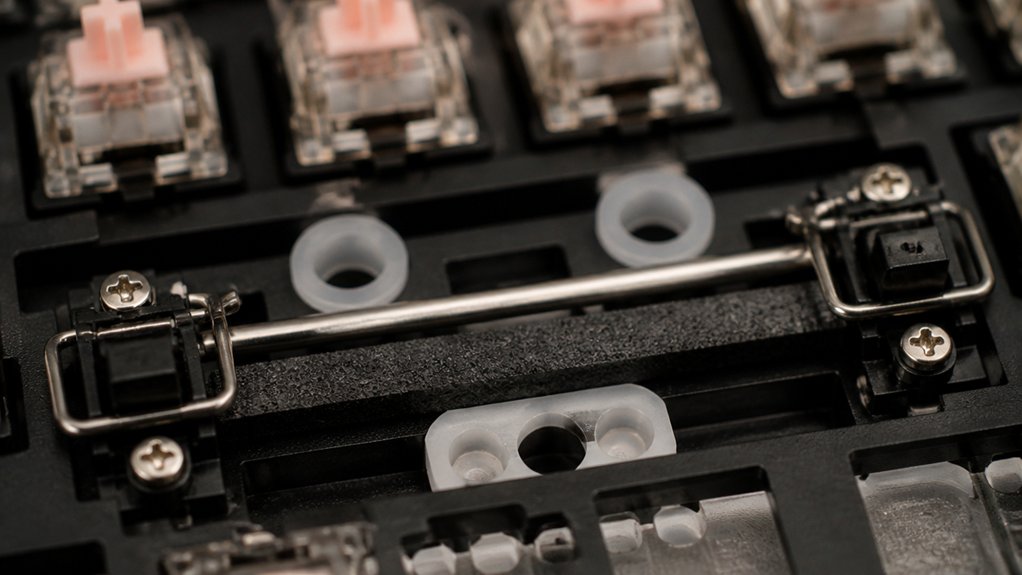
O-rings act as soft cushions that dampen the impact when your keycaps hit the switch stems, effectively muffling the typical plastic-on-plastic sound. By absorbing some of the force, these small rubber rings reduce keyboard noise considerably, often lowering it by about 6 decibels. Selecting the right foam dampeners can further enhance this noise reduction by shaping the sound profile and providing additional vibration control. This creates a quieter, more comfortable typing experience on both linear and tactile mechanical switches. O-rings fit around the center columns of switch stems and may require multiple rings for larger keys with multiple stems, ensuring thorough noise reduction. Installing them involves removing keycaps, placing the rings onto the switch stems, and reseating the keys—taking roughly five minutes. Overall, O-rings help you enjoy quieter typing without sacrificing the feel of your mechanical switches.
How to Install O-Rings on Your Mechanical Keyboard
To install O-rings on your keyboard, begin by removing all keycaps with a keycap puller. This exposes the switch stems, making it easier to place the O-rings.
Carefully slide a rubber O-ring around the center column of each switch stem; for larger keys like spacebar and backspace, use multiple O-rings due to multiple stem columns.
Once all O-rings are in place, reattach the keycaps, guaranteeing they fit snugly and function correctly. The process typically takes about 5 minutes for a standard 104-key keyboard.
If you’re purchasing O-rings through custom orders, be sure to review the seller’s Return Policy and Terms of Service to confirm satisfaction and correct fit, especially since installation is straightforward but irreversible without keycap removal. Additionally, attention to stabilizer tuning can further improve key feel and sound performance after installing O-rings.
How Much Noise Do O-Rings Actually Reduce?

O-rings can considerably cut down your keyboard noise by softening the impact of key presses, with an average reduction of about 6 decibels on Cherry MX Red and Brown switches.
They work well on both quiet and tactile switches, including clicky blue types, delivering noticeable sound dampening. How much noise they reduce depends on the switch type, but you’ll likely see a real difference in your typing environment.
Decibel Level Reduction
Installing rubber O-rings on mechanical keyboard switches can considerably lower the noise you produce while typing. They reduce the average sound level by about 6 decibels, damping the harsh plastic-on-plastic impact. This change makes typing quieter without sacrificing feel or performance.
Whether you use quiet linear switches like Cherry MX Red or tactile switches like Cherry MX Brown, the noise reduction is similar. Real-world recordings show a clear, unedited decrease in sound, making your typing much less disruptive.
The cost is usually around $10 for enough dampers to cover a full-size keyboard. Keep in mind, if you’re concerned about privacy or noise policies, the modest reduction helps guarantee your keyboard noise stays within acceptable limits, while your Return Policy and Terms of Service remain unaffected.
Effectiveness Across Switch Types
Regardless of your switch type, rubber O-rings are highly effective at reducing typing noise. They can cut the average noise level by about 6 decibels on Cherry MX Red (linear) and Brown (tactile) switches.
O-rings soften the impact when keys bottom out, muffling the harsh plastic-on-plastic sounds common across many mechanical keyboard switches. This physical damping works well on both “quiet” linear and tactile switches, providing broad compatibility.
Even with louder clicky blue switches, O-rings markedly dampen noise, making typing quieter without sacrificing too much feedback. Installing O-rings is a simple, affordable modification that enhances acoustic performance across switch categories.
A key benefit is that they help reduce vibration and resonance within the keyboard, contributing to a sound dampening effect that improves overall typing comfort.
Comparing O-Rings to Other Keyboard Soundproofing Methods
When evaluating different keyboard soundproofing options, it’s important to take into account both ease of installation and effectiveness. O-rings are an affordable, quick retrofit that can greatly dampen typing noise by about 6 decibels, primarily reducing the harsh plastic-on-plastic bottoming-out sound. They’re easy to install—just about five minutes for an entire keyboard—and require no disassembly or switch replacement. Additionally, foam dampening methods often utilize materials like Poron foam, which is known for its sound absorption properties and ability to effectively reduce resonance and vibrations. Compared to silent mechanical switches, which use quieter stem designs and materials to lessen noise at the source, O-rings are less invasive and more budget-friendly. Keyboard foam dampening, on the other hand, involves disassembling the keyboard and adding damping material inside, often offering superior soundproofing but with higher effort and cost.
Each method varies in simplicity and effectiveness, so choose based on your needs.
Are O-Rings Suitable for All Switch Types?

O-rings generally work well across various switch types, including linear, tactile, and clicky blue switches, by dampening the impact noise. However, larger keys with multiple stems may need multiple O-rings, making installation a bit more involved. Additionally, the effectiveness of O-rings can depend on material quality, with more durable rubber providing better noise reduction and longevity. Keep in mind, while they reduce sound, O-rings don’t eliminate the tactile or click sound from certain switches, and some custom switches might require special-sized rings.
Compatibility With Switch Variants
O-rings are compatible with most mechanical switch types, including linear, tactile, and clicky variants, making them a versatile solution for noise reduction. A simple addition of O-rings can significantly reduce bottom-out sound, especially when using switches with a pre-lubrication quality, which already enhances smoothness and sound dampening. Whether you’re using a mechanical keyboard with different switch types, installing O-rings can soften the impact of keycaps bottoming out, lowering noise. For larger keys like spacebar and backspace, you’ll need multiple O-rings to guarantee effective dampening across all switch types. While some silent switch variants already feature noise reduction, adding O-rings provides extra sound dampening without changing the switch feel. Even clicky switches like Cherry MX Blues benefit from physical damping, greatly reducing their distinctive noise. Although installation takes about five minutes per full keyboard, O-rings suit all switch types, offering a practical way to enhance quiet operation across your setup.
Effectiveness on Clicky Switches
Although clicky switches like Cherry MX Blues produce distinct, audible clicks, adding O-rings can still effectively reduce overall noise levels. O-rings dampen the bottoming-out sound, muffling the harsh plastic-on-plastic impact that contributes to typing noise.
While the clicky sound remains mechanically, O-rings soften the impact noise without eliminating the tactile click, lowering the overall noise by about 6 decibels on both quieter linear and louder tactile switches. This simple and affordable solution benefits all switch types, including clicky blue switches, by decreasing keyboard sound without sacrificing function.
However, proper installation around the switch stem is essential to prevent interference with key travel or tactile feedback, helping you achieve quieter typing while maintaining the switch’s distinctive click.
Impact on Typing Feel
While O-rings are effective at reducing noise by cushioning keycap bottoming-out impacts, their influence on the overall typing feel varies depending on your switch type. For linear and tactile switches like Cherry MX Red and Brown, O-rings soften landings without changing the switch’s fundamental feel.
However, on clicky switches such as Blue, they mainly reduce noise but don’t eliminate tactile feedback. Larger keys with multiple stems may need more O-rings for consistent dampening, which can slightly alter key travel and crispness.
Some users notice a reduction in tactile response, especially with precise feedback-focused switches. Before making modifications, review the Privacy Policy, Terms of Service, and Return Policy of your manufacturer or retailer to guarantee compatibility and satisfaction with your soundproofing choices.
Pros and Cons of Using O-Rings for Noise Dampening

Using O-rings to dampen noise on a mechanical keyboard offers several immediate benefits. They soften the impact of keycaps bottoming out, reducing typing noise by around 6 decibels.
A typical O-ring set, costing about $10 and including 135 rings with a keycap puller, can outfit a full-size keyboard. Installing these rings is straightforward but labor-intensive; you’ll remove keycaps, slip the rings onto switch stems, and reassemble in about 5 minutes. Larger keys require multiple O-rings for consistent noise reduction.
While effective at minimizing keystroke noise across linear, tactile, and clicky switches, they don’t eliminate noise caused by other components like metal backplates. Overall, O-rings provide a practical, budget-friendly noise dampening solution for many users.
How to Choose the Best O-Ring Kits and Sizes for Your Keyboard
Choosing the right O-ring kit and size for your keyboard depends on understanding your specific needs and switch types. Look for kits like Rosewill’s, which include 135 rings and a keycap puller, enough to outfit a full-size keyboard with 104 keys at around $10.
Make certain your O-rings fit snugly around the center columns of your switch stems for effective noise dampening without hindering key travel. Larger keys, such as the spacebar or backspace, require multiple O-rings, so confirm your kit has enough rings for these keys.
Consider O-ring thickness and hardness—thicker or softer rings offer more noise reduction but may slightly change key feel. For bulk needs, explore wholesale options or custom orders to get the perfect fit for your switch type, whether linear, tactile, or clicky.
Do O-Rings Affect Your Typing Feel or Performance?
O-rings can slightly change how your keys feel by reducing travel distance and softening impact. While they lower noise without sacrificing much tactile feedback, they might influence your keystroke rhythm.
Changes in Keypress Tactility
While rubber O-rings effectively reduce noise from key bottoming out, they can also soften the tactile feedback you feel during typing. This change impacts the tactile experience, subtly reducing the “bump” sensation designed into custom switches.
For some users, this means a slightly less pronounced response, altering the overall feel in line with personal preferences or corporate policy on workstation noise. Larger keys with multiple stem columns tend to experience more damping, which can further diminish tactility.
Despite this, most typists find that O-rings maintain acceptable performance levels without sacrificing accuracy. If you prioritize a quieter keyboard without losing too much tactility, O-rings serve as a simple solution.
Still, it’s important to weigh the impact on your preferred switch feel before deciding on this soundproofing method.
Impact on Typing Noise
Rubber O-rings are effective at dampening the noise generated when keys bottom out, but many users wonder if this impact extends beyond sound to influence their typing feel or performance. By softening the impact of keycaps hitting the switch stems, they substantially reduce harsh plastic-on-plastic sounds, creating a more soundproof keyboard experience.
However, this noise reduction can slightly alter your key travel distance and bottoming feel, which may mildly affect how your typing experience feels. Larger keys with multiple stem columns benefit from multiple O-rings, maintaining noise reduction without sacrificing key stability.
Influence on Keystroke Response
The addition of O-rings introduces subtle changes to your keystroke response by cushioning the impact when keys bottom out. These small rubber rings sit on the stem’s center column, slightly reducing the keystroke’s travel distance—typically by 0.1 to 0.2 millimeters.
This minor adjustment can change how the keystroke feels, making it softer and less tactile at bottom-out, which some users notice. While O-rings help dampen noise and soften the keystroke, they may also create a perception of reduced responsiveness or feedback.
However, most find that this slight decrease in travel doesn’t impair typing speed or accuracy. Larger keys or multiple O-rings can amplify these effects, though many users still prioritize the quieter and softer feel over any minimal performance changes.
When Should You Upgrade Your Keyboard for Quiet Typing?
Wondering when it’s time to upgrade your keyboard for quieter typing? If you often type in shared spaces or during late hours, it’s a clear sign. Additionally, if your keystrokes produce loud bottoming out sounds amplified by a metal backplate, a switch upgrade can help. Silent mechanical keyboard switches, like the Kinetic Labs’ Gecko Silent Linear or Wuque Studio WS Silent, offer strong noise reduction for quiet typing. When noise complaints increase or simple damping modifications like O-rings don’t work, switching to silent switches becomes necessary.
| Situation | Solution | Result |
|---|---|---|
| Working in shared spaces | Upgrade to silent switches | Noise minimizes |
| Loud bottoming out sounds | Switch to silent stems (pre-lubed or not) | Quieter keystrokes |
| Noise complaints during work | Use specialized silent switches | Up to 6 dB noise reduction |
| Limited noise reduction with O-rings | Consider switching for better noise reduction | Improved quiet typing |
Tips for Further Silence: Other Soundproofing Techniques
To achieve even quieter typing, you can explore additional soundproofing techniques beyond switch modifications. Adding rubber O-rings between keycaps and switch stems softens bottoming-out sounds and reduces noise by around 6 decibels.
Installing foam or silicone sound dampening mats inside the keyboard case further absorbs vibrations and minimizes noise amplification from the metal backplate. Using lubricants on switch stems and springs decreases friction noise and creates smoother keystrokes, while replacing stock stabilizers with lubed and clipped versions lessens rattling on larger keys like spacebar and shift.
Choosing thicker, sound-absorbing keycaps, such as PBT with textured surfaces, also helps decrease plastic-on-plastic impacts. When customizing your keyboard, check the seller’s Custom Orders options and confirm compliance with Privacy Policy and Terms of Service for the best soundproofing results.
Benefits of Quiet Mechanical Keyboards for Work and Shared Spaces
Silent switches and soundproofing techniques make mechanical keyboards much quieter, creating a more comfortable environment for work and shared spaces. Using silent switches like the Kinetic Labs Gecko Silent Linear or Turtle Silent Tactile reduces typing noise considerably, helping you focus without distracting colleagues.
Installing rubber O-rings can further decrease keystroke noise by about 6 decibels, softening the impact of keypresses. These noise reduction measures benefit open offices, libraries, and shared work areas by minimizing the harsh plastic-on-plastic sounds that often occur with standard mechanical keyboards.
Affordable silent switch options, such as Wuque Studio WS Silent or Chosfox Summer Lime Silent Linear, deliver effective noise reduction without high costs. Overall, quiet mechanical keyboards promote a more productive, less disruptive environment.
Troubleshooting O-Ring Installation and Performance Issues
Are your O-rings not providing the expected noise reduction or feel? First, check that the O-rings are correctly placed around the center columns of each switch stem. Improper placement can cause uneven cushioning and lessen noise dampening.
For larger keys with multiple stem columns, use multiple O-rings to fully absorb impact noise and prevent rattling or inconsistent key feel.
If your keycaps feel loose or are difficult to reinstall, verify they’re compatible in size and that the O-rings are seated properly on the switch stems. Worn or low-quality O-rings may also impair soundproofing—consider replacing them with higher-grade rubber.
Always review the Return Policy and Terms of Service if you encounter persistent installation or performance issues to guarantee proper support and replacement options.
Frequently Asked Questions
What Are the Quietest Switches for a Mechanical Keyboard?
The quietest switches for a mechanical keyboard are Kinetic Labs’ Gecko Silent Linear and Turtle Silent Tactile, Wuque Studio WS Silent, and Chosfox Summer Lime Silent Linear switches, all designed to minimize noise with pre-lubed, smooth operations.
Do Gamers Prefer Membrane or Mechanical?
You prefer mechanical keyboards because they offer better response times, tactile feedback, and durability, which are essential for gaming precision. Membrane keyboards are quieter but lack the responsiveness and customization that make mechanical keyboards the top choice for gamers.
What Is a 96% Keyboard Missing?
A 96% keyboard is missing a dedicated number pad, extra function keys, macro keys, and some media controls. You gain a compact size and portability, but sacrifice a few specialized keys you might need for specific tasks.
Why Do People Like Silent Switches?
You like silent switches because they minimize noise, creating a peaceful typing experience. They reduce disturbance in shared spaces, feel smooth and satisfying, and cater to your preference for quiet, whether you’re working, studying, or gaming.