
To guarantee stable, rattling-free keypresses, match your stabilizer type with your keycap profile. Cherry-style stabilizers work well with OEM and Cherry profiles, especially taller ones like SA or MT3, while Costar stabilizers need compatible keycap inserts. The mount type, size, and keycap profile influence fit and stability, so verify these details beforehand. For smoother, quieter keys, proper lubrication and clipping help. Keep exploring for detailed tips to optimize your setup perfectly.
Understanding Stabilizer Types and Their Role in Keycap Fit

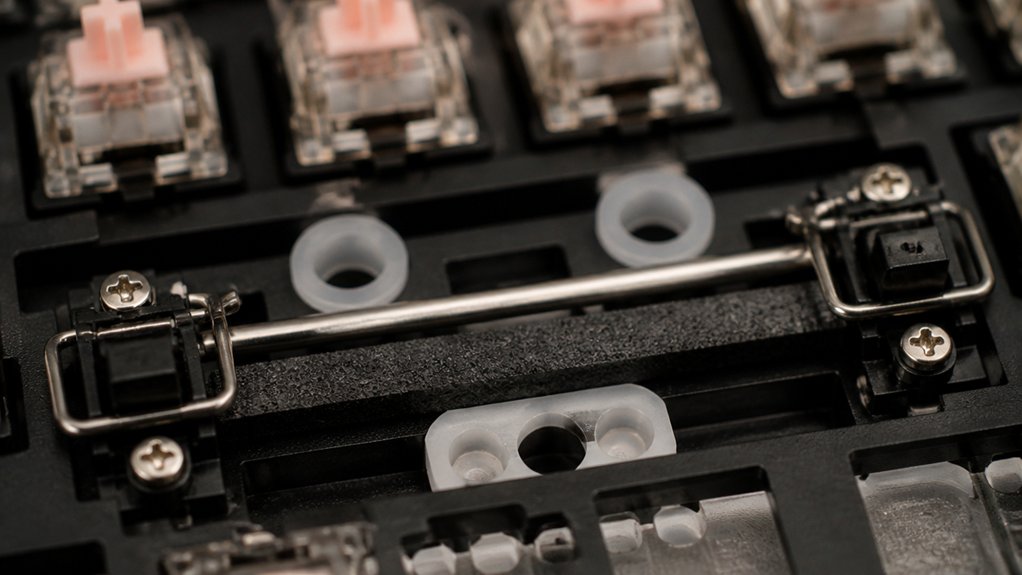
Understanding stabilizer types is essential because they directly affect how well your larger keys fit and feel on your keyboard. Stabilizers, crucial for keys like the spacebar and Enter, come mainly in Cherry-style and Costar types, which influence keycap compatibility. Most aftermarket keycap sets support Cherry-style stabilizers, which insert wires into the housing, making them easier to install. Costar stabilizers, however, clip wires inside the keycap, requiring specific wire clip inserts to guarantee proper fit. Choosing incompatible stabilizers and keycaps can cause key rattling, uneven presses, or instability on larger keys. To keep your keyboard performing reliably, always verify that your stabilizer type matches your keycap set, ensuring a stable, wobble-free typing experience and consistent keypress feel. Additionally, selecting the right stabilizer mount type can simplify installation and maintenance over time.
How Keycap Profiles Affect Stabilizer Compatibility
The profile of your keycaps greatly impacts stabilizer compatibility, especially for larger or specialty keys. Taller or uniquely shaped profiles, like SA or MT3, may interfere with stabilizer housing clearance, influencing keycap seating and typing feel. Cherry-style stabilizers generally work with most keycap profiles, but low-profile or custom caps often require verification for wire clearance. Costar stabilizers need keycaps with specific wire clips, so profile choice is critical to prevent incompatibility or damage. Larger keys with stabilizers require keycaps with suitable mounting points and space, which can be affected by the profile’s sculpting height and angle. Here’s a quick overview:
| Keycap Profile | Stabilizer Compatibility | Notable Features |
|---|---|---|
| SA/MT3 | May need verification | Taller, sculpted |
| OEM/Cherry | Highly compatible | Standard height |
| Low-profile | Limited; verify fit | Slim, shallow |
Additionally, understanding the stabilizer material quality and how different profiles interact can help prevent issues like rattling or uneven keypresses.
Common Causes of Stabilizer Wobble and Rattle

Stabilizer wobble and rattle often happen when the stabilizer wire fits loosely within its housing, leading to excessive movement and noisy keystrokes. Common causes include:
- Using stabilizers that don’t match the stabilizer size, creating gaps that cause wobbling.
- Incorrectly seated keycap sets, especially on larger keys like spacebars and Enter, which amplify instability.
- Employing stabilizers incompatible with your keycap mounts (Cherry vs Costar) or missing necessary inserts, increasing looseness.
- Failing to lube or damp stabilizer components properly, resulting in rattling and unstable keystrokes.
- Neglecting to perform routine stabilizer maintenance, such as cleaning and lubrication, can also lead to increased wobble and noise over time.
Addressing these issues guarantees tighter fitting stabilizers, reducing wobble and noise. Proper size matching and compatible keycap sets are essential for a stable, smooth typing experience.
How to Identify Your Keyboard’s Stabilizer Mount and Size
Do you know how to identify your keyboard’s stabilizer mount and size? Start by removing a larger keycap, like the spacebar or Enter, to inspect the stabilizer.
Identify your stabilizer mount and size by removing a large keycap to inspect the type and measure the key.
Stabilizer mounts come in two main types: Cherry-style, where the wire clips into the housing, and Costar-style, which clip the wire directly into the keycap with specific inserts.
To determine the size, measure the length of the stabilized key—common sizes include 6.25u for spacebars and 2u or 2.25u for Shift keys. Most aftermarket keycaps support Cherry-style stabilizers, but Costar stabilizers require keycaps with dedicated clip-in slots.
Knowing your stabilizer type and size guarantees compatibility, proper fit, and a solid typing feel. Additionally, understanding the mounting methods can help you choose stabilizers that minimize wobble and noise during use.
Choosing the Right Stabilizer for Your Keycaps and Mounts

Choosing the right stabilizer depends on your keycaps and mounting style. To guarantee a stable and satisfying typing experience, consider these factors:
- Type compatibility: Cherry-style stabilizers are widely compatible with most aftermarket keycaps and are usually the best choice for diverse keycap sets.
- Keycap design: Costar stabilizers clip into the keycap itself, but require specific inserts, limiting compatibility with custom keycap sets.
- Key size: Larger keys like spacebar, Enter, and Shift need matching stabilizer sizes and types to prevent wobble or uneven travel.
- Mount style: Confirm that stabilizer mount type aligns with your keyboard and keycap set to guarantee proper fit and function.
Choosing the right stabilizer maximizes your keyboard’s performance and keycap stability.
Troubleshooting Wobbly Stabilizers on Low-Profile Keys
When low-profile keys wobble, the issue often stems from mismatched stabilizer types and improper installation. Low-profile switches like Kailh Choc V2 or Gateron KS-33 require stabilizers that align precisely with the switch housing and keycap mounts.
Wobbly low-profile keys often result from mismatched stabilizer types and poor installation alignment.
Using stabilizers designed for larger keys or incompatible inserts causes loose fit and wobbling. Cherry-style stabilizers usually fit better with low-profile switches due to their wire insertion method, reducing play and offset.
Check that the stabilizer wire length and housing fit snugly into the stabilizer block and keycap socket. Avoid using stabilizers with mismatched keycap profiles or those not rated for low-profile switches.
Proper matching of stabilizers and keycaps effectively minimizes wobble and enhances stability during typing.
How to Modify Stabilizers for Better Fit and Function

To improve the fit and function of stabilizers, modifying them through clipping, lubricating, and adjusting is essential. For Cherry profile stabilizers, start by:
- Removing the plastic housing legs and applying dielectric grease on the wire and housing to reduce rattle and improve sound.
- Ensuring Costar stabilizer wires are clipped securely into keycap inserts and correctly aligned to prevent wobble.
- Adjusting stabilizer wire length and position to avoid interference with keycap travel, especially on larger keys like spacebar and Enter.
- Swapping factory wires for thicker or softer metal variants to boost stability and quieten keystrokes.
Considering band-aid or filmed modding techniques on housing bottoms also softens bottom-out impact and enhances typing comfort on your mechanical keyboard.
Which Stabilizer Mounts Are Compatible With Your Keycap Profile?
Choosing the right stabilizer mount depends on your keycap profile and its specific design. You need to take into account stabilizer types, such as Cherry or Costar, and whether your keycaps can accommodate their mounting methods. Additionally, consider the mounting style—such as PCB screw-in, plate-mounted, or snap-in—to ensure a secure fit with your keyboard build. Ensuring compatibility minimizes wobble, rattling, and uneven keypresses, so double-check your keycap’s size and profile before making a choice.
Stabilizer Mount Types
Understanding your stabilizer mount type is essential for ensuring your keycaps fit properly and function smoothly. Different stabilizer mounts impact compatibility and ease of installation, especially with Cherry-style, mechanical key switches.
Here are the main types:
- Cherry-style: These stabilizers insert the wire into the housing, making them compatible with most aftermarket Cherry-style keycaps.
- Costar: Clip directly into the keycap with specific inserts, requiring compatible keycaps for a proper fit.
- OEM and aftermarket options: Often designed for Cherry stabilizer mounts, ensuring broad compatibility.
- Size considerations: Larger keys like spacebars need stabilizers that match their mount type, preventing wobble and ensuring smooth keystrokes.
Verifying your stabilizer mount type before sourcing keycaps guarantees smooth, stable performance. Additionally, understanding the sound damping features of stabilizers can significantly improve typing acoustics and feel.
Keycap Profile Variations
Different keycap profiles can impact how stabilizers fit and function on your keyboard. The profile, or shape, of your keycap affects the compatibility with stabilizer mounts. For example, Cherry-style stabilizers, which insert their wire into the housing, are versatile and widely compatible with most aftermarket keycaps, including OEM, Cherry, and SA profiles. Conversely, Costar stabilizers require keycaps with specialized wire clip inserts, typically found in OEM and Cherry profiles. Tall profiles like SA or KSA usually support Cherry-style stabilizers because their design accommodates the wire-insert method. Low-profile keycap profiles for specialized switches often need profile-specific stabilizers that align precisely with the shape and stem of the keycap. Ensuring compatibility between stabilizer type and keycap profile is crucial for optimal fit and stabilizer performance. Always verify your profile’s compatibility to guarantee proper stabilizer fit and function.
Compatibility Considerations
The compatibility between stabilizer mounts and your keycap profile is essential for guaranteeing proper fit and stable operation. Cherry MX stabilizers are versatile and widely compatible with most aftermarket keycaps because they insert the wire into the housing, providing reliable support for modifier sizes.
However, if you use Costar stabilizers, you’ll need keycaps designed with Costar inserts, or they won’t clip correctly, leading to instability. Always check if your keycap set supports Costar compatibility to prevent issues with larger keys.
Additionally, stabilizer size variations—like standard or non-standard lengths—must match your keycap set’s stabilizer specifications for a secure fit. Confirm the stabilizer type before purchasing to avoid mismatches and secure peak performance across your keycap profile. Ensuring compatibility involves verifying that stabilizers are built with appropriate material compatibility to prevent degradation over time.
Impact of Keycap Material and Profile on Stabilizer Performance
Keycap material and profile directly influence how stabilizers perform, affecting both sound and feel during typing. Different keycap materials, like PBT and ABS, produce distinct sound profiles—PBT yields a deeper, muted “thock,” while ABS creates a brighter, higher-pitched clack on stabilized keys.
Taller profile keycaps, such as SA or MT3, can increase noise and may lead to interference or instability if the stabilizer wire strikes the underside of the keycap. Conversely, low-profile and flat profile keycaps reduce the lever arm effect, resulting in a more stable, less wobbly experience, especially on larger keys.
The sculpting pattern—spherical versus flat tops—and keycap material also influence how firmly stabilized keys feel, affecting rattling and clipping tendencies. Additionally, anti-grease coatings on high-quality PBT keycaps help maintain a clean feel over extended use, which can impact stabilizer performance by reducing residue buildup.
Lubrication and Clipping Techniques to Improve Stabilizer Stability

To enhance stabilizer performance, proper clipping and lubrication are essential steps in assembly and maintenance. Clipping involves trimming excess plastic from stabilizer stems to prevent interference with keycap movement, making larger keys like the spacebar, Enter, and Shift more stable.
Lubrication, using dielectric grease or Krytox, minimizes rattle and smooths keypresses by reducing friction at contact points and along wires.
Here are key techniques:
- Clip stabilizer stems carefully to eliminate unnecessary plastic tabs.
- Lubricate stabilizer wires, housings, and contact points thoroughly.
- Focus on areas prone to wobble and noise.
- Combine clipping with lubrication for ideal stability and sound dampening.
- Using high-quality keyboard tools like openers and pullers can make the process more precise and efficient.
Mastering these steps greatly improves stabilizer performance and key feel.
OEM vs. Stepped vs. Plate-Mounted Stabilizers: What’s Best?
Are you trying to decide which stabilizer type best suits your build? OEM stabilizers, typically PCB-mounted, are compatible with most aftermarket keycaps and offer moderate stability, reducing rattle and improving typing feel.
Stepped stabilizers, found mainly on larger keys like Backspace and Caps Lock, have a staggered height that requires specific keycap profiles to fit properly.
Plate-mounted stabilizers attach directly to the keyboard plate, providing firmer, less rattly key presses, but they often limit keycap compatibility due to the stabilizer mount design. They also usually require larger stabilizer insert holes and are incompatible with Costar-style wires.
Your choice impacts large key stability, typing experience, and level of keycap compatibility—consider your priorities when selecting between OEM, stepped, and plate-mounted stabilizers.
When and Why to Replace or Upgrade Your Stabilizers
Upgrading or replacing your stabilizers is essential when you notice excessive wobbling or rattling on larger keys, as these issues can detract from both typing comfort and sound quality. Such problems often indicate your stabilizers aren’t functioning at their best.
Replacing stabilizers improves typing stability and sound quality on larger keys.
Consider replacing them if:
- You experience persistent wobbling or rattling on spacebar, Enter, Shift, or Backspace keys.
- The sound becomes noisy or inconsistent during typing.
- Your stabilizers aren’t compatible with your keycap profile, causing keycap tilting or uneven pressure.
- You want better performance from high-profile or custom keycap sets, which often demand precise stabilizer fit.
Upgrading to lubed Cherry-style stabilizers or ensuring keycap profile compatibility can greatly improve your typing experience and overall keyboard performance.
Tips for Installing Stabilizers for Wobble-Free Typing
Properly installing stabilizers is essential for achieving wobble-free typing, especially on larger keys like spacebar and Enter. First, confirm your Cherry-style stabilizers are clipped correctly and seated securely in the keyboard plate before installing keycaps. Lubricate the stabilizer wires and sliders with a quality dielectric grease to minimize friction noise and stabilize the stabilizers. To tighten fit and improve stability, use band-aid or clipping mods on Cherry stabilizer inserts. Check that your keycaps are compatible with the stabilizer type—incorrect inserts on Costar stabilizers can cause wobble. After installation, test larger stabilized keys for uniform travel and tilt, adjusting tension and seating as needed.
| Step | Action |
|---|---|
| Clipping and Seating | Confirm Cherry stabilizers are properly clipped and seated |
| Lubrication | Apply dielectric grease to wires and sliders |
| Modding | Use band-aid or clipping mods for tighter fit |
| Testing | Verify stability and adjust if wobble persists |
Final Tips for Achieving Smooth, Stable Keypresses Across Profiles
Ensuring smooth, stable keypresses across different keycap profiles depends heavily on compatibility and proper installation. To optimize your setup:
- Check that stabilizer housings don’t interfere with the keycap profile, especially on larger keys like spacebar and enter, to prevent uneven feel or rattling.
- Opt for Cherry-style stabilizers, which generally work better across various profiles compared to Costar stabilizers that need specific inserts.
- Use thicker, well-fitted keycaps to reduce wobble and boost stability, regardless of profile height or shape.
- Confirm that the keycap stem receptacles align correctly with stabilizer wires to prevent offset installation and inconsistent key travel.
Applying these tips helps achieve consistent, smooth keypresses across all your keycap profiles.
Frequently Asked Questions
How Do Stabilizer Types Affect Keycap Profile Compatibility?
Different stabilizer types influence how well keycaps fit, especially with various profiles. You’ll want to match stabilizer style—like Cherry or Costar—with your keycap profile to guarantee stability, comfort, and avoid keycap wobbling during typing.
Can Different Stabilizer Brands Be Interchangeable on the Same Keyboard?
Yes, different stabilizer brands can be interchangeable on the same keyboard, but compatibility varies. You should check the stabilizer type and size, as some brands may have slightly different mounting styles or fitments that affect performance.
Are There Specific Stabilizers Designed for High-Profile Keycaps?
Yes, there are stabilizers specifically designed for high-profile keycaps, often smaller or tailored to fit their shape. You should check the stabilizer’s specifications to guarantee compatibility, as some may not fit or operate smoothly with high-profile caps.
How Does Stabilizer Size Vary Between Different Keycap Profiles?
Stabilizer size changes with keycap profiles, generally growing larger for taller keycaps like SA or DSS to guarantee stability and proper fit. You need to match stabilizer size to your keycap profile for peak performance.
Do Custom Stabilizers Improve Performance Across All Keycap Profiles?
Custom stabilizers can improve your typing experience across various keycap profiles by providing smoother, more stable keystrokes. However, their effectiveness varies; guarantee compatibility based on your specific keycap profile and switch types for peak performance.